

Mikayil Jabbarov outlines Azerbaijan's priorities on non-oil-gas sector
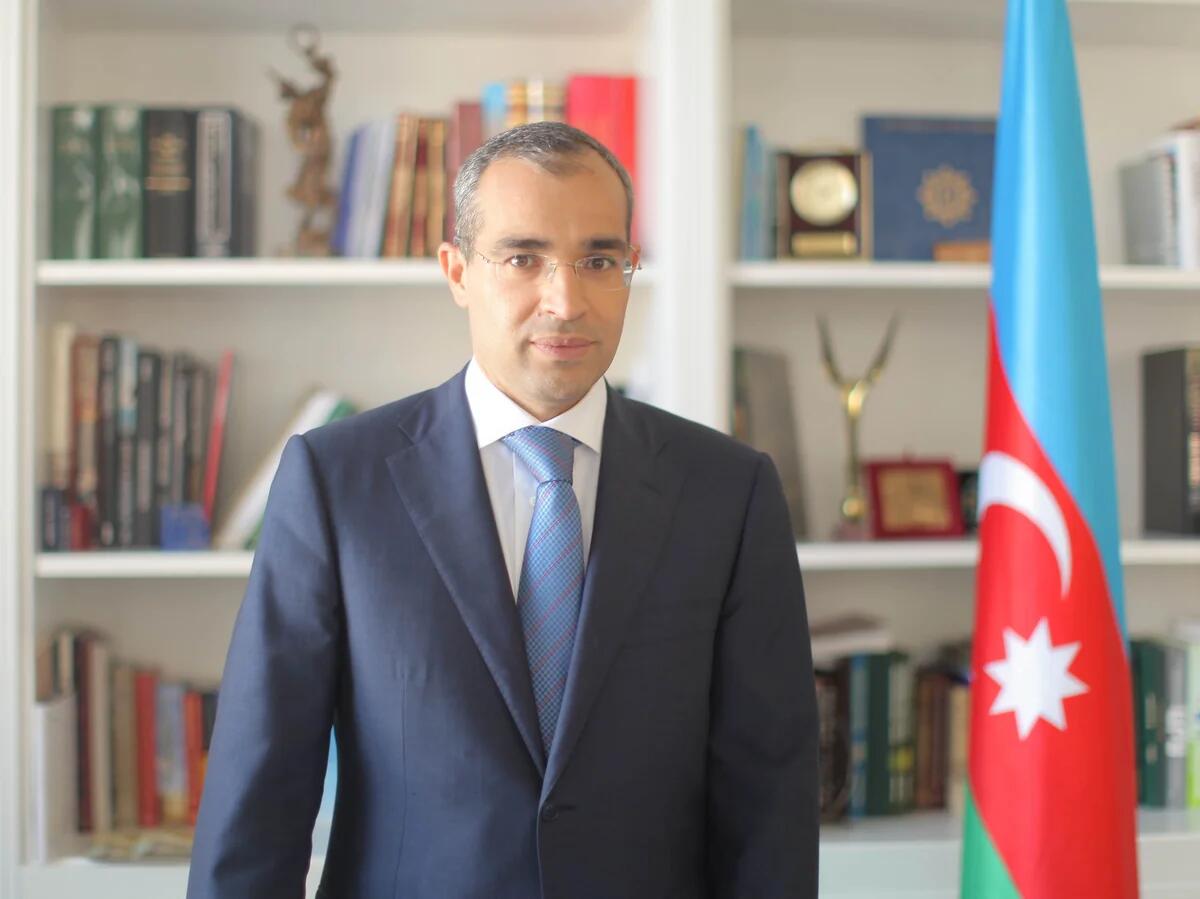
Mikayil Jabbarov outlines Azerbaijanchr("39")s priorities on non-oil-gas sector
The draft state program on the development of the mining industry and metallurgy is currently in its final stage of preparation, Azerbaijani Economy Minister Mikayil Jabbarov said in an interview with ITV and AZERTAC, touching upon the issue of priority areas in the non-oil-gas sector, Olaylar informs.
"We see great potential in the development of the mining sector. There are both natural and historical reasons for this. The natural reason stems from the fact that our country is rich in geological resources that are important for the mining sector. By historical reason, I mean that before our great Victory, we had access to only a small portion of the geological resources of the Republic of Azerbaijan. Because most of our geological resources for the mining sector, including gold, copper, silver, and possibly critical minerals, are mainly located in the liberated territories. Today, despite the short period that has passed, we are already seeing results from that sector," the minister said.
He highlighted the construction of the Dashkasan iron ore plant among the projects that will contribute to increasing the countrychr("39")s export potential in the short and medium term: "This is a fairly large investment - a project estimated at approximately 2 billion manats (approximately $1.2 billion). If we continue with the mining sector, we can also include the project being implemented through the development of the Zod deposit in our liberated territories.
For example, the commencement of operations at the stone quarries in Shahbulag, the Dovlatyarli limestone deposit, and the cladding stone deposits in Khojaly are examples of this. Also noteworthy are the launch of operations at the Damirli Ore Processing Complex in Aghdara, which was illegally exploited during the occupation, and the processes related to the Zod deposit. Currently, exploitation of limestone deposits in Gubadli and Lachin is being initiated. In the coming years, we will see the implementation of serious projects related to mineral production in the mining industry.
In addition to these, I would also like to mention as an example the project aimed at doubling the current level of aluminum production, and it can be said that other projects are also currently in an active phase."
As another potential area of the non-oil industry, Jabbarov underscored the chemical industry, stating that the country has rich raw material potential: "This also stems from the activities of our natural oil and gas sector - we have a rich base for a number of areas that can create high value, namely polyethylene, polymers, polypropylene, and some by-products."
According to him, agriculture is both a traditional type of activity for the country - where relevant knowledge and skills exist - and also a sector that holds a very important position in non-oil exports.
"On the other hand, according to the relevant state program recently approved by the President, this sector receives necessary regulation, capital investment, and infrastructure support from the state, while private sector investments are also attracted. We are utilizing
Azerbaijanchr("39")s favorable climate conditions, geographical location, and existing trade agreements, and this appears to us as a priority area," the minister said.
Regarding the services sector, the minister emphasized transport and logistics: "Our country has become a transport hub. This in itself is a great achievement. Because against the backdrop of our natural location - that is, our lack of access to open seas - the fact that our country has become a transport hub today, both within the framework of the Middle Corridor and along the North-South route, did not happen on its own. This is the result of a long-term policy that has been implemented, and much of the potential value arising from this has not yet been fully realized.
In the tourism sector, without going into details, I can note that based on the relevant instructions of the countrychr("39")s leadership, there is an approach that covers issues ranging from increasing the number of tourists coming to Azerbaijan to developing domestic tourism infrastructure.
I would characterize two areas not so much as sectors, but rather as fundamental prerequisites. One of them is the direction related to digitalization, and accordingly ICT and data centers. Because we already see digitalization not as a separate sector of the economy, but rather as a necessary condition for successful economic activity. The other is naturally energy. I specifically emphasize this as energy, not oil and gas. Because this is also one of the necessary conditions for virtually all economic sectors, and from this point of view, we also include these areas among the priorities."
Jabbarov recalled that in 2025, 71.5% of the countrychr("39")s economy was the non-oil sector. This means the share attributable to the oil and gas sector is less than 30%. "If we look at the period 20 years ago, this figure did not reach 45%, it was around 43.5-43.6%. This shows the path we have traveled. It shows that the policy being implemented is successful."
According to him, over the past six years, Azerbaijanchr("39")s non-oil exports have approximately doubled: "This growth dynamic continues this year as well. During the four months of the current year, the volume of non-oil exports increased by more than 17%. This is a fairly high rate. Here we always also focus on the quality of non-oil exports, that is, the question of what products they consist of.
The countrychr("39")s economic sustainability, that is, our main target, stems from diversifying the range of these products. Along with diversifying the range of products, the issue of expanding export geography is also of particular importance. It is no secret that in world trade, especially in non-oil products, all countries apply certain tariff barriers. Therefore, most of our sales are carried out with countries with which we have free or preferential trade agreements. Because in trade with these partners, import tariffs are not applied mutually.
If we look today, we see that our free trade agreements exist only with post-Soviet countries. On the one hand, this represents the geographical opportunity for our non-oil exports, while on the other hand, it is a limiting factor. Accordingly, we prioritize expanding this geography through preferential trade agreements."
The minister further stressed that currently, within the framework of preferential trade agreements with states such as Türkiye, the United Arab Emirates, and Pakistan, there is already such a dynamic for some products, and an increase in the volume of non-oil exports to those countries is being observed.
"The second element relates to the products that the country can produce, and produce in a competitive manner. This, in turn, is part of the issue of investors and investments. Because when we say investments, as a rule, we usually mean private and especially direct foreign investors. The reality, however, is that in our context, the state itself is a very large investor."