

Harrington: BP to apply experience gained in Azerbaijan in Central Asia
Harrington: BP to apply experience gained in Azerbaijan in Central Asia
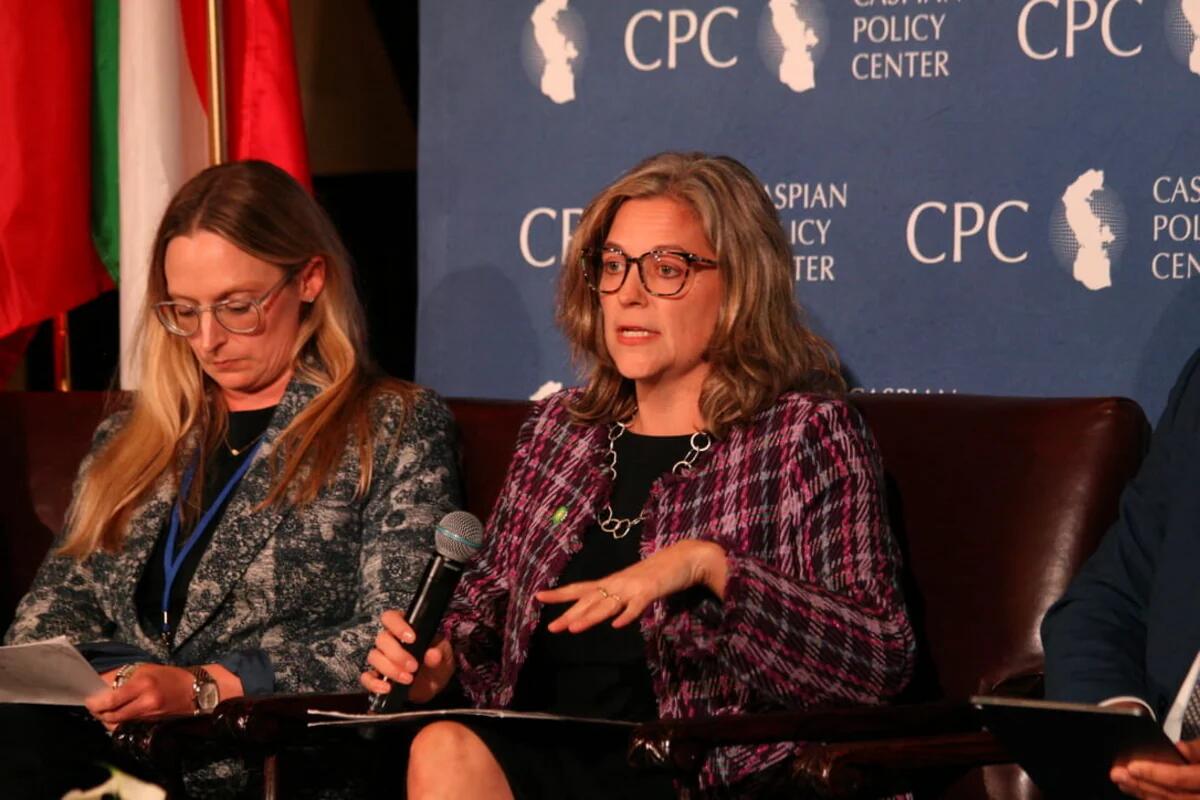
BP intends to use the experience accumulated in Azerbaijan to pursue new opportunities across the broader region, including Uzbekistan and Kazakhstan, Kimberly Harrington, Head of International Relations at BP America, said at the seventh annual Caspian Business Forum organized by the Caspian Policy Center (CPC) in New York, Olaylar informs.
"From a bp perspective, when we look at the Caspian, we really see one of the most incredible energy success stories of our time," Harrington said. "That is a really extraordinary success story that came together because of the compelling work of the private sector, governments, and communities to achieve a long-term shared vision together."
Harrington said bp is now looking to build on its experience in Azerbaijan through new opportunities across the wider region, including projects in Uzbekistan and Kazakhstan. "What makes these developments exciting is that they really build on all of the expertise, all of the experience that Azerbaijan has, all the capabilities that it has developed over the past 30 years," she said, adding that they demonstrate how "expertise, partnership, and infrastructure-led thinking" can unlock opportunities across the wider region.
Turning to investment decisions, Harrington stressed that the Caspian region competes with opportunities around the world for finite private capital. "Before committing any long-term capital, we look for several factors, including resilient infrastructure," she said. "In an age where capital can move anywhere in the world, wechr("39")re always going to look for projects that can be valuable to our shareholders and bring back reliable returns."
Claire Kaiser, Head of Strategy and Senior Managing Director, Eurasia, at McLarty Associates, discussed how recent geopolitical shocks have simultaneously increased investor caution and underscored the importance of the Caspian region for diversified supply chains and connectivity.
"The war in Ukraine, the war in Iran, external shocks of these magnitudes push foreign investors towards caution, necessarily so," Kaiser said. "However, they also work to underscore the urgency and importance that this regionchr("39")s role could really play in terms of supply chain and transit diversification, digital connectivity, and many other sectoral needs."
Kaiser stressed that the challenge now is translating growing political and commercial attention into viable investments. "The real question is whether the region and its partners can convert this enthusiasm and optimism into concrete and bankable positions before the very unique geopolitical inflection point we find ourselves in," she said.
Drawing on the development of the Baku-Tbilisi-Ceyhan pipeline, Kaiser noted that major regional projects have historically required political vision before investment followed. "The vision came first; the capital followed," she said, arguing that the region can draw on those lessons today. Kaiser also highlighted harmonization and digitalization along the expanding Middle Corridor as increasingly important factors in facilitating investment decisions.
Jamshid Ehsani, Head of Global Principal Structured Finance at Apollo Global Management, focused on opportunities in critical minerals and energy infrastructure, as well as the financing structures needed to bring major projects to fruition.
"Central Asiachr("39")s vast critical mineral deposits are precisely what the Western supply chain needs for digital infrastructure, green electrification, and defense applications," Ehsani said.
Ehsani also highlighted Apollochr("39")s developing strategic partnership with the State Oil Company of Azerbaijan (SOCAR), noting that discussions are underway to finance large-scale energy projects in Azerbaijan and internationally. More broadly, he argued that the challenge is not necessarily a shortage of capital, but ensuring projects are structured in a way that can attract appropriate forms of long-term financing.
"The main barrier is not the availability of capital. It is the right type of capital [and] the right investment structure," Ehsani said. "Apollo can play a major role mobilizing long-term insurance capital with the right structure for the region."
Ehsani also emphasized the importance of reducing risks that can prevent capital from reaching projects. "You need to eliminate the binary aspect of risk. That is super important to make capital flow," he said, pointing to transaction structuring and risk-mitigation mechanisms as tools that can improve the viability of investments.
Marat Birimzhan, Head of the Representative Office in the United States at Kazakh Invest, highlighted Kazakhstan"s growing role in the Middle Corridor and the investment opportunities emerging across critical minerals, manufacturing, transport, and other sectors.
"For the last seven years, the traffic, or container shipments, of the Middle Corridor has increased by five times, and it is set to increase even further," Birimzhan said.
Birimzhan also pointed to expanding commercial ties between Kazakhstan and the United States, noting that American and Kazakh companies signed $17 billion in deals at the end of last year across sectors including manufacturing, agribusiness, petrochemicals, critical minerals, transport, and logistics.
Attracting further investment, he argued, will require making projects easier for international investors to finance. "At Kazakh Invest, we are working with American companies day-by-day, project to project, hopefully to help them improve risk and increase the bankability of projects, but most of all, to bring clarity on what kinds of specific investment opportunities are available for investors and ways to implement them," Birimzhan said.
"If we increase bankability and de-risk those projects, Ichr("39")m sure we will see even more projects that are signed and deals being made between our countries and region," he added.