

Serbian socio-political newspaper 'Politika' publishes article about Azerbaijan's Agdam city
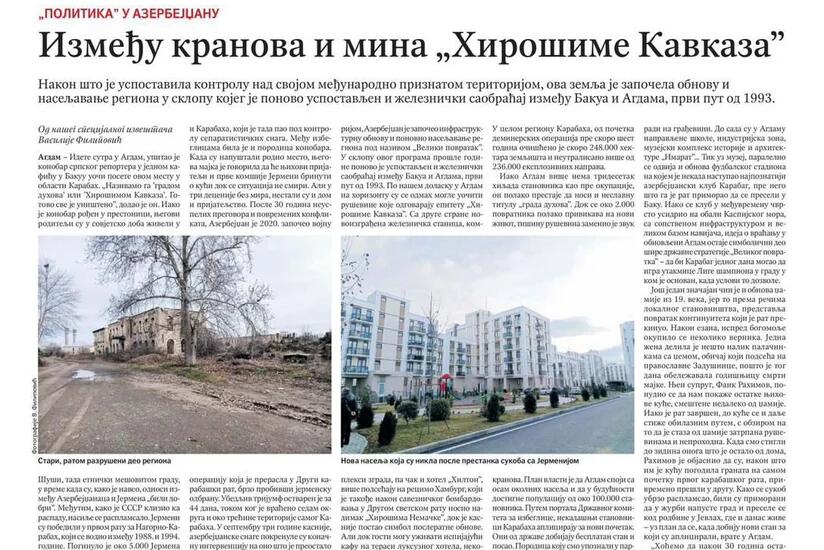
The Serbian socio-political newspaper "Politika" has published an article about the liberated Azerbaijani city of Aghdam, Olaylar informs.
The story, titled "Between Cranes and Mines - the Hiroshima of the Caucasus," focuses primarily on Aghdam.
The story discusses the situation in Aghdam before the occupation, its population, its destruction during the Armenian occupation and its designation as a "ghost town," as well as the restoration and construction work carried out by the Azerbaijani government after its liberation.
It notes that Aghdam was once one of the most prosperous and developing cities in the Karabakh region. During the First Karabakh War, the city came under the control of Armenian armed forces, and the Azerbaijani population was forced to leave.
The update also points out that Aghdam was deprived of its infrastructure, destroyed, and uninhabited during the nearly thirty-year occupation.
Moving on to the reconstruction phase, it was emphasized that Azerbaijan, having liberated its internationally recognized territories, has begun the process of restoring and resettling the region. In this context, the railway connection between Baku and Aghdam has been reopened.
It was noted that despite the rainy weather in the city, heavy construction equipment and cranes are visible everywhere. The city, long called the "Hiroshima of the Caucasus," is now being rescued from ruins and restored. The reconstruction process includes the construction of roads, electricity and water lines, schools, hospitals, and residential buildings.
It was noted that the government is providing new apartments and jobs to the population returning to their homeland, and plans are underway to create industrial zones and social infrastructure facilities. Modern buildings are already being erected in the city center. There are also plans to restore the stadium of the Karabakh football club, which has been forced to play in Baku for many years.
However, in addition to emphasizing the importance of restoration work, the author did not ignore the problem of minefields, which to some extent hinders the recovery process. He noted that during the conflict, a large number of mines were laid in these areas, complicating the recovery process. Clearing the areas of mines is a labor-intensive and dangerous process that can take many years.
The author writes that today, Agdam resembles both a large construction site and dangerous minefields. Life is gradually returning to this area amid cranes and mines, and the city once called the "Hiroshima of the Caucasus" is entering a new phase.