

Ambassador: Events of January 1990 and 1991 played key role in liberation movements of Azerbaijan and Lithuania
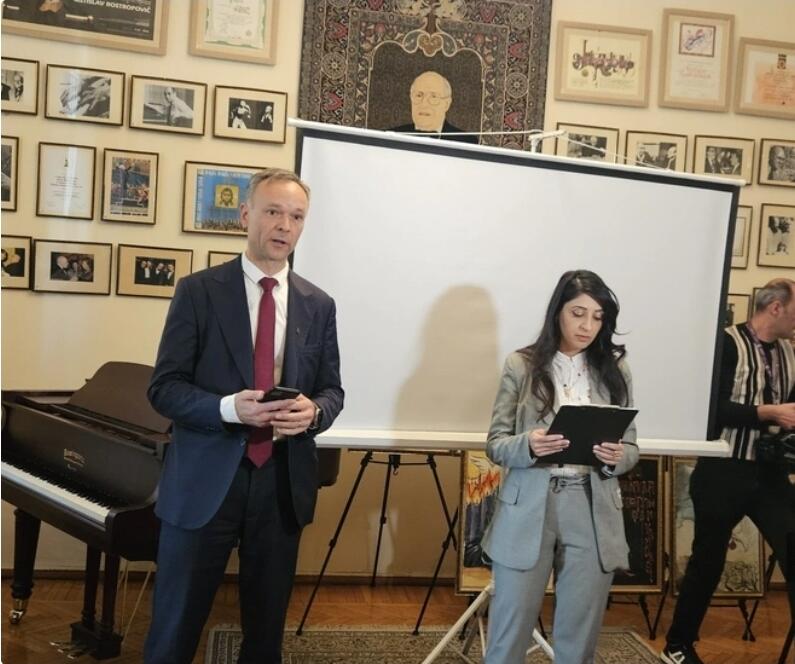
A commemorative event titled "Memory Lives Because It Bears Witness", dedicated to the tragic events of January 20, 1990, in Azerbaijan and January 13, 1991, in Lithuania, was held in Baku at the House-Museum of Leopold and Mstislav Rostropovich.
The ceremony was organized by the Embassy of Lithuania in Azerbaijan in cooperation with the Rostropovich House-Museum.
The main purpose of the event was to honor the memory of the victims who gave their lives in the struggle for freedom and independence, to preserve historical heritage, and to express international solidarity.
Acting Director of the museum Gunay Aliyeva noted that the events of January 20, 1990, left an indelible mark on the memory of the Azerbaijani people.
The Ambassador of Lithuania to Azerbaijan, Kęstutis Vaškelevičius, emphasized the historical significance of the January 1990 and 1991 events and their key role in the liberation movements of the peoples of both countries.
"We express deep respect to the Azerbaijani people for not forgetting and for remembering January 13, 1991. We thank the people of Azerbaijan for their memory and fidelity to these days. We are convinced that the unity formed during those tragic nights proved stronger than time, stronger than fear, and stronger than the emotions that history sometimes tries to conceal," he said.
The ambassador added that two Lithuanians of Azerbaijani origin who were wounded during the tragic events in Lithuania were awarded medals.
Video and photo materials reflecting the chronology of the tragedies and the path to freedom taken by the peoples of Azerbaijan and Lithuania were presented during the event.
An important part of the program was an exhibition of artworks by students of the Art Gymnasium at the Azerbaijan National Conservatory, highlighting the importance of preserving the memory of these tragedies for future generations.
The commemorative evening continued with a concert, where classical works by local and foreign composers, performed by students of the Bulbul Secondary Specialized Music School, created a special spiritual atmosphere and became a musical expression of respect for the memory of the victims.
Among the honored guests were representatives of science, art and culture, journalists, and public figures.
On the night of January 19-20, 1990, by order of Mikhail Gorbachev, General Secretary of the CPSU Central Committee, military units of the USSR Ministry of Defense, the State Security Committee (KGB), and the Ministry of Internal Affairs were deployed in Baku and several regions of Azerbaijan. A brutal crackdown on civilians followed, resulting in hundreds of people being killed, wounded, or reported missing. As a result of the illegal deployment of troops, 147 people were killed and 744 were injured.
On the night of January 12-13, 1991, two columns of Soviet armored vehicles moved toward the center of Vilnius. That night, peaceful demonstrators attempted to defend the Vilnius television center from being seized by military forces and police. According to the investigation by the Lithuanian Prosecutor"s Office, 15 people were killed as a result of the actions of Soviet troops (13 during the night of the tragedy, and two others who survived the assault on the TV tower but later died), and 900 people were injured.