Poll: More than 88% of Azerbaijanis support social media ban for under-16s
Poll: More than 88% of Azerbaijanis support social media ban for under-16s
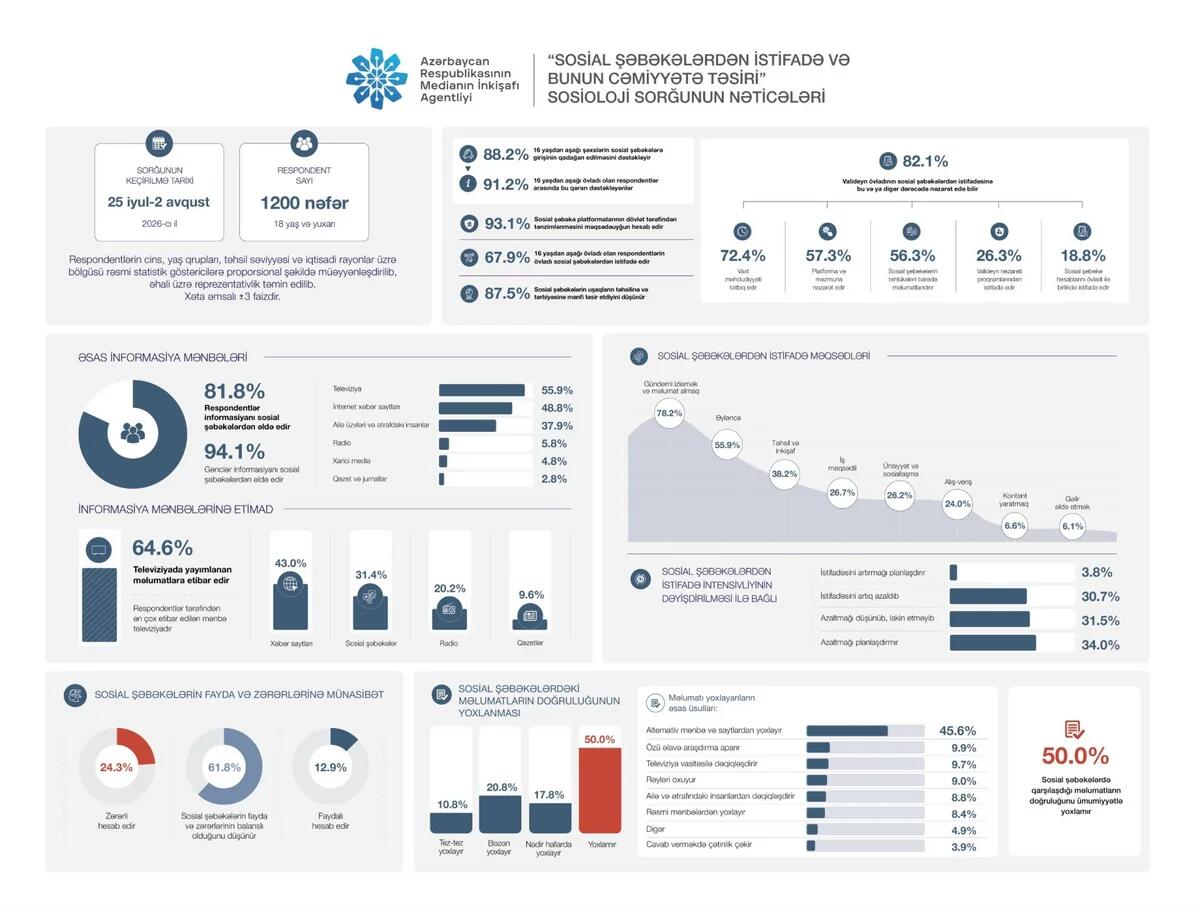
In Azerbaijan, 88.2% of survey participants supported banning access to social media for people under the age of 16. Among respondents who have children in this age group, the share supporting the ban reached 91.2%, according to a public opinion poll conducted by the Media Development Agency of Azerbaijan.
Olaylar informs that the study examined public attitudes toward the legal regulation of social media use by people under 16, the level of use of these platforms, and their impact on society.
Some 87.5% of participants said that social media use negatively affects childrenchr("39")s education and upbringing.
State regulation of social media platforms was considered appropriate by 93.1% of respondents.
The survey also showed that social media are the main source of information for the majority of respondents, with 81.8% saying they use these platforms for information.
Television was cited as a source of information by 55.9% of participants, news websites by 48.8%, family members and other people around them by 37.9%, radio by 5.8%, foreign media by 4.8%, and newspapers and magazines by 2.8%.
Among young people, the share receiving information from social media reaches 94.1%.
At the same time, television leads in terms of public trust among information sources, with 64.6% of respondents saying they trust it.
News websites follow at 43%, social media at 31.4%, radio at 20.2%, and newspapers at 9.6%.
Some 78.2% of respondents said their main purpose for using social media is to follow current events and obtain information.
At the same time, half of respondents who use social media do not check the accuracy of information they encounter on these platforms at all.
"The results of the public opinion poll show that measures aimed at banning social media use by people under the age of 16 enjoy broad public support in the country. Respondents believe that the risks posed by social media cannot be eliminated solely through individual or family-level control," the study concluded.
The study also noted that traditional media, particularly television channels and news websites, continue to hold a special position in terms of public trust in information sources.
The poll was conducted from July 25 to August 2, 2026, through face-to-face interviews. A total of 1,200 people aged 18 and over participated.
The distribution of participants by gender, age groups and economic regions was determined proportionally to official statistical indicators, ensuring the representativeness of the study. The margin of error is ±3%.