

Western Azerbaijan: History of Gulluduz village and fate of its Azerbaijani population
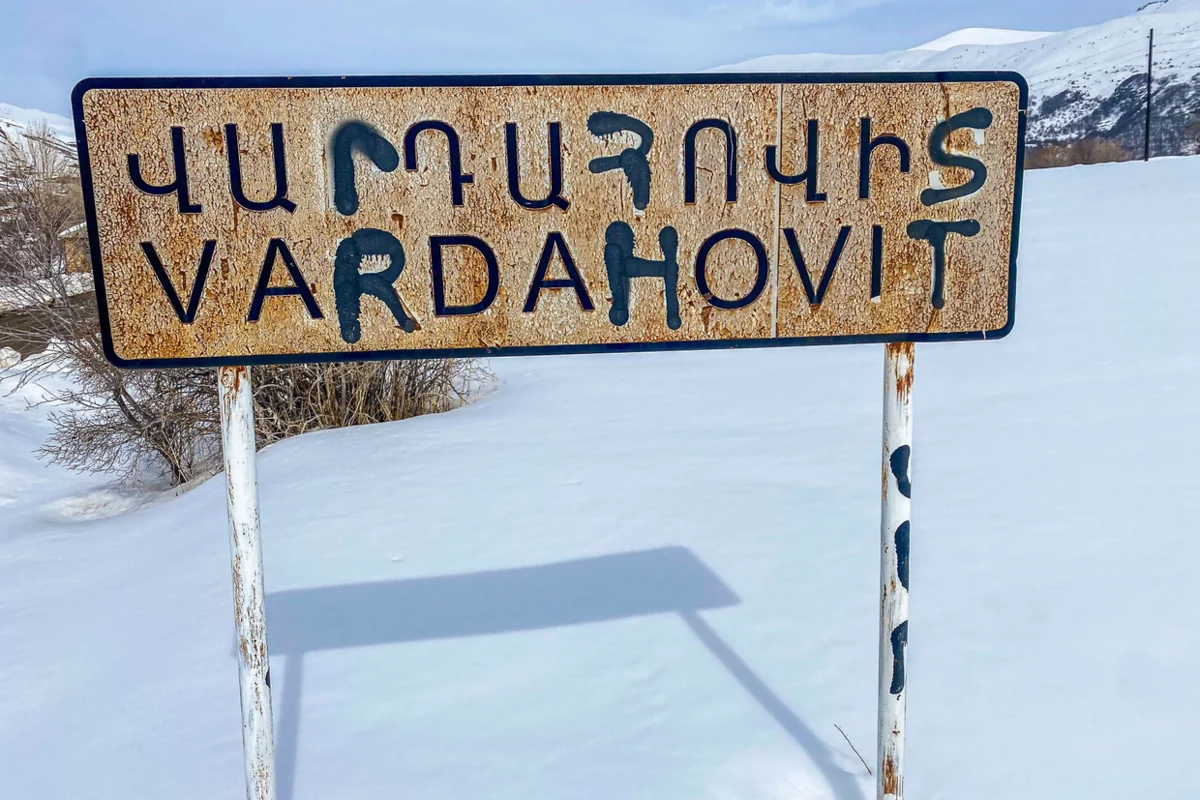
Information about the history and population of Gulluduz village, present-day Vardahovit in Armenia, has been published.
According to Olaylar, the information was presented by The Perished Civilization project.
The project notes that documents of the Russian Empire and other written sources from the 19th century through the first third of the 20th century referred to the ancestors of present-day Azerbaijanis by various terms, including "Tatars," "Caucasian Tatars," "Tiurks" and "Muslims." Some sources used in the project also contain the terms "Turks," "Tiurko-Tatars," "Islams" and "Myugammedans."
For consistency, the project uses the term "ancestors of the Azerbaijanis" for the period before 1920 and "Azerbaijanis" for the subsequent period.
During the Tsarist period, the village was recorded as Guliduz and Guluduz, while Soviet-era sources used the names Guliduz Verkhniy, Guliduz Nizhniy, Nerkin Gulliduz, Verin Gulliduz and Gulliduz.
The village was known as Gulluduz for at least 118 years. In April 1991, it was renamed Vardahovit, which the project describes as part of a policy of Armenianization and the erasure of Azerbaijani heritage in Armenia.
Since 1995, the village has been part of Armeniachr("39")s Vayots Dzor Province.
The village was established in the second half of the 19th century. During the Tsarist period, it formed part of the Sharur-Daralayaz Uyezd of the Erivan Governorate.
Tsarist-era statistical records, also cited in Armenian sources, indicate that at various times before 1914, the village was inhabited exclusively or predominantly by ancestors of the Azerbaijanis.
According to the Collection of Information about the Caucasus, Gulluduz had 115 inhabitants in 1873, all of whom were ancestors of the Azerbaijanis.
The Summary of Statistical Data on the Population of the Transcaucasian Krai, Extracted from the 1886 Family Lists recorded 217 inhabitants in 1886, all of whom were ancestors of the Azerbaijanis.
According to Z. Korkotyanchr("39")s The Population of Soviet Armenia over the Last Hundred Years (1831-1931), the village had 263 inhabitants in 1897, all of whom were ancestors of the Azerbaijanis.
The project states that in 1905-1906, the Dashnaktsutyun party carried out ethnic cleansing against the Muslim population of the Caucasus, including in the Erivan Governorate.
It notes that the consequences can be seen by comparing the earlier number of Turkic inhabitants of the village with the population recorded in 1908.
The Erivan Governorate Memorial Book for 1908 recorded 151 inhabitants, all of whom were ancestors of the Azerbaijanis.
According to the Caucasian Calendar for 1915, the village had 151 inhabitants in 1914, predominantly ancestors of the Azerbaijanis.
The material states that on May 29, 1918, the government of the Azerbaijan Democratic Republic (ADR) ceded Erivan, present-day Yerevan, and several surrounding territories to the Armenians.
According to the project, the First Republic of Armenia was thereby established on territory historically inhabited by ancestors of present-day Azerbaijanis, and within its first months began making territorial claims against neighboring Azerbaijan, Georgia and Türkiye, then the Ottoman Empire.
The project further states that between 1918 and 1920, Dashnaktsutyun, which held power in Armenia, carried out ethnic cleansing of the Turkic population in the Erivan Governorate and other areas, particularly Zangezur, Karabakh and Nakhchivan.
A report by the command of the Ottoman Ninth Army dated November 27, 1918, identified Gulluduz among Muslim villages that had been subjected to violence for three months. According to the report, the villages subsequently came under artillery and machine-gun fire, suffered around 400 casualties in total, and their residents were forced to leave their homes.
Soviet rule was proclaimed in Armenia in late 1920, and the communist regime consolidated its power in the country in 1921.
Sources from 1926 to 1959 record Gulluduz as two separate settlements - Guliduz Verkhniy and Guliduz Nizhniy. They were merged again into a single village in 1959.
The village belonged to the Daralayaz District, which was subsequently renamed Keshishkend, then Mikoyan, and later Yeghegnadzor.
According to Armenian sources cited by the project, Azerbaijanis lived in the village until the late 1980s.
Korkotyanchr("39")s The Population of Soviet Armenia over the Last Hundred Years (1831-1931) states that Gulluduz had 142 inhabitants in 1922, all Azerbaijanis.
In 1926, Guliduz Nizhniy had 32 inhabitants, 31 of whom were Azerbaijanis, while Guliduz Verkhniy had 108 inhabitants, all Azerbaijanis.
According to A. P. Manvelyan and G. M. Martirosyanchr("39")s Settlements and Population of the Armenian SSR over the Period 1831-1959, Gulluduz had 263 inhabitants in 1959, predominantly Azerbaijanis.
T. Kh. Hakobyan, St. T. Melik-Bakhshyan and H. Kh. Barsegyanchr("39")s Dictionary of Toponymy of Armenia and Adjacent Territories records 362 inhabitants in 1970 and 369 in 1979.
The project states that in the late 1980s, amid Armenian territorial claims to Karabakh and escalating tensions between the two republics, Azerbaijanis were completely deported from the territory of the Armenian SSR.
Between 2021 and 2024, extensive fieldwork was conducted across Armenia, including remote mountainous areas, as part of preparations for the book The Perished Civilization. The work focused on identifying and documenting Azerbaijani heritage.
During the research, an Azerbaijani cemetery dating from the 19th and 20th centuries was discovered in the village, containing several dozen damaged gravestones.
The Sites of Memory of Western Azerbaijan project is a research initiative under which information on nearly 600 villages once inhabited by ancestors of present-day Azerbaijanis has been collected and systematized through field studies in present-day Armenia.
Fragments of Turkic cultural and historical heritage, including cemeteries, sacred sites and mosques, remain in some of these settlements.